OpportunityHub
Designing a responsive platform for discovering opportunities
Designing a responsive platform that helps users discover and manage opportunities.


Role:
UX/UI Designer . End-to-end design
Platform:
Web · Tablet · Mobile
Introduction
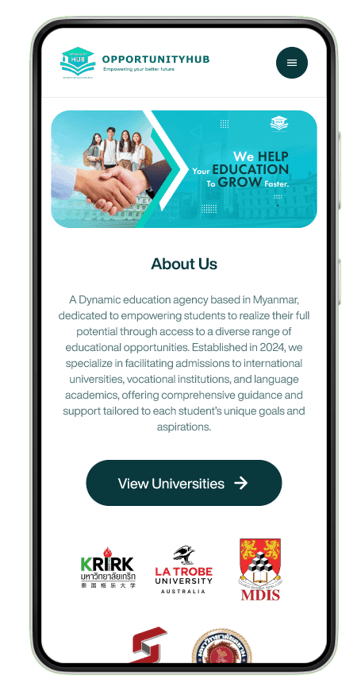
Opportunity Hub is a responsive web platform designed to connect aspiring students with leading international universities across Thailand, Singapore, and Australia.
By providing in-depth information about the institutions, programs, and application processes, Opportunity Hub aims to guide students toward making informed decisions about their higher education. With established contracts with five prestigious universities, the platform serves as a trusted bridge between students and international opportunities, offering a seamless experience for users across all devices.
Opportunity Hub needed to make it easier for users to discover, understand, and act on opportunities without being overwhelmed by information or navigation.
The Purpose
The primary purpose of designing Opportunity Hub is to empower students by simplifying the process of exploring and applying to international universities.
Personalized Guidance
To offer tools that help students find the best-fit universities based on their academic interests, budget, and career aspirations. This includes search filters, recommendation features, and resources that simplify decision-making.
Global Opportunities
To support students in exploring international education by providing valuable insights into the universities across Thailand, Singapore, and Australia, encouraging cross-border learning and cultural exchange.
Seamless Application Process
To streamline the application process by providing clear guidance and resources, ensuring that students can efficiently submit applications and track their progress through a unified platform.
Seamless Application Process
To aggregate all relevant details about universities, programs, scholarships, and application processes into one user-friendly platform, reducing the complexity of researching and comparing options.
Key Problems
Defining a complex product
Opportunity Hub brings together different types of opportunities, information, and user actions. The challenge was creating a structure users could understand without feeling overwhelmed.
Making discovery intuitive
Users need to quickly understand what opportunities are available, which ones are relevant, and what they can do next.
Designing one experience across devices
The product needed to work as a consistent experience across desktop, tablet, and mobile, rather than treating responsive design as an afterthought.
The Challenge
There was no existing product experience to optimize. I needed to define the structure, user experience, and visual system from the ground up.
Main Challenges
Defining a complex product
Opportunity Hub brings together different types of opportunities, information, and user actions. The challenge was creating a structure users could understand without feeling overwhelmed.
Making discovery intuitive
Users need to quickly understand what opportunities are available, which ones are relevant, and what they can do next.
Designing one experience across devices
The product needed to work as a consistent experience across desktop, tablet, and mobile, rather than treating responsive design as an afterthought.
The Research
Student Needs & Preferences
Globalization of Education
With increasing demand for international education, students are looking for streamlined platforms that can simplify the search and application process. Opportunity Hub targets this need by offering a centralized place where students can explore various universities and their programs across different countries.
Mobile-First Behavior
Students increasingly access information via mobile devices. Research from Statista and similar sources indicates that over 50% of web traffic globally is from mobile devices, making responsive design critical. Opportunity Hub is designed with a mobile-first approach to ensure a seamless experience for users on the go.
Financial and Program Information
Students often seek detailed information about scholarships, program costs, and job opportunities after graduation. Opportunity Hub’s research highlights the importance of providing transparent financial aid options, career outcomes, and personalized recommendations.
University Insights & Collaboration
Partnership Models
Universities benefit from platforms like Opportunity Hub by reaching a broader audience of international students. Research into university recruitment strategies shows a growing reliance on digital platforms for student outreach, especially post-pandemic, with many universities entering into partnerships with platforms that can promote their programs globally.
Regional Focus
The initial focus on universities in Thailand, Singapore, and Australia aligns with growing trends in international education. These countries have robust educational systems that attract students from around the world. Research indicates that universities in these regions are actively seeking ways to connect with students digitally, and platforms like Opportunity Hub help fill that gap.
Competition & Differentiation
Competitive Landscape
There are various education platforms like UniAgents, IDP, and StudyPortals that connect students to universities. However, Opportunity Hub differentiates itself by offering a region-specific focus (Thailand, Singapore, Australia) and maintaining contracts directly with the universities, ensuring accurate and exclusive information.
User-Centered Design
Competitor platforms often suffer from poor user experience and complex navigation. Opportunity Hub focuses heavily on creating a responsive, user-friendly design that simplifies the discovery and application process, ensuring students can access the information they need quickly and without friction.
Technological Considerations
Responsive Web Design
As Opportunity Hub is being developed with responsiveness at its core, research into best practices for responsive design highlights the importance of flexibility, fast load times, and intuitive navigation across devices. The platform uses modern technologies like HTML5, CSS3, and JavaScript frameworks that enable it to function smoothly on all screen sizes.
Research for Opportunity Hub focuses on understanding the needs of students seeking international education, the recruitment strategies of universities, and the competitive landscape of digital education platforms.
The platform aims to fill a niche by focusing on a select group of countries and providing a superior user experience through responsive design, personalized recommendations, and strong university partnerships.
Usability Testing Method for Opportunity Hub
To make sure that Opportunity Hub delivers a seamless and user-friendly experience, usability testing was conducted using a variety of methods. The goal of the testing was to evaluate the platform’s interface, ease of navigation, responsiveness, and the overall experience for students and university partners.
Moderated Remote Usability Testing
Method
In this method, participants were guided through a series of tasks over a remote video call while being observed by a moderator. The moderator asked participants to complete tasks such as searching for universities, filtering results by country or program, and submitting an inquiry or application.
Purpose
This allowed for real-time feedback and clarification of any confusion users encountered, making it possible to gather insights into the user’s thought process and experience.
Participants
10 participants, including students interested in international education and university representatives, were selected to provide diverse perspectives.
Unmoderated Usability Testing
Method
Participants were given access to the platform and asked to complete specific tasks independently without live interaction. Their actions were recorded, and a survey was provided afterward to capture their feedback on ease of use and any issues they encountered.
Purpose
This method was used to simulate real-world conditions, where users would be using the platform on their own. It helped identify any usability challenges that might not be apparent in moderated testing.
Participants
15 participants, with a mix of students and education consultants, engaged in the test, offering insights from both student and professional perspectives.
Card Sorting
Method
This technique was used to help organize the platform’s navigation and information architecture. Participants were asked to group related content (e.g., university information, scholarship details, program offerings) in ways that made sense to them.
Purpose
Card sorting provided insights into how users expect information to be categorized, ensuring that the site’s navigation aligns with their mental models.
Participants
8 participants, primarily students, were involved in card sorting activities to fine-tune the platform’s structure.
Usability Testing Results
The results from usability testing provided actionable insights for improving Opportunity Hub. Key findings include:
User Experience
Positive Findings
Most participants found the platform visually appealing and were impressed by the clear, modern design. The responsive nature of the platform was praised, with users noting that it adapted well across devices.
Areas for Improvement
Some participants experienced difficulty finding specific programs due to the abundance of options. It was suggested that filters could be more prominently displayed or pre-categorized to simplify the search.
Navigation
Positive Findings
Navigation was intuitive for the majority of participants, especially on desktop versions. The card sorting exercises helped refine the menu structure, leading to improvements in how information was grouped.
Areas for Improvement
A few participants encountered challenges while navigating on smaller screens (e.g., smartphones). The menu options needed slight adjustments to ensure ease of access without excessive scrolling.
Application Submission Process
Positive Findings
Participants appreciated the clear steps outlined in the application process. The presence of a progress bar and well-placed tips during form submission were particularly well-received.
Areas for Improvement
A few participants found the application form slightly lengthy and suggested breaking it into more digestible sections. Auto-saving of progress was also recommended to avoid data loss in case of disruptions.
Feedback on Personalization
Positive Findings
The personalized recommendation engine was considered a valuable feature by students, helping them discover programs that matched their academic background and preferences.
Areas for Improvement
Some users felt that the recommendations could be refined further by incorporating more personal factors such as budget and long-term career goals.
Performance & Speed
Positive Findings
Users reported fast load times and appreciated the lack of lag when switching between pages, especially on mobile devices.
Areas for Improvement
A small percentage of users encountered slower performance when submitting large files (e.g., application documents). Optimization in this area was suggested.
The usability testing results provided critical insights for enhancing Opportunity Hub’s user experience, especially for mobile and international users. Overall, the platform performed well, with high user satisfaction for the design, navigation, and personalization features. The feedback received has been used to refine the platform, with particular attention paid to improving navigation on smaller screens, simplifying the application process, and enhancing the personalization engine for better student recommendations.
Information Architecture


Fig: Information Architecture and its iteration according to user research and usability testing
User Flow
User want to know details about study programs in Singapore.
User search on google about study program in SG.
User found OPTHub and redirect to the landing page.
User view landing page and click “View Universities”.
User filtered the universities in SG from selects “All, SG, Thailand, Australia”.
User found universities in SG and click on “MDIS university”.
User found short details about the MDIS university and its programs.
User choose the desired program and download the detail file in pdf.
User view the program details about tuition fees, timeline and intakes.
User contact us and discuss with the desired program that he/she wish to attend.
Low-Fidelity Wireframes

DESIGN EXPLORATION

Key Design Decisions
Creating a clear content hierarchy
Problem
Users may encounter a large amount of opportunity information.
Decision
I established a hierarchy that prioritizes the information users need to understand an opportunity before exposing secondary details.
Structuring opportunity discovery
Problem
Users need to navigate multiple types of opportunities.
Decision
I grouped opportunities into understandable categories and created consistent patterns for browsing and filtering.
Designing reusable UI patterns
Problem
A platform with many screens can quickly become inconsistent.
Decision
I created reusable patterns for cards, buttons, forms, navigation, and content sections.
Designing responsive behavior
Problem
The experience needed to work beyond desktop.
Decision
I adapted layouts, hierarchy, navigation, and components for smaller screens rather than simply shrinking the desktop layout.
Final Product
Explore the experience
Experience the Opportunity Hub prototype and explore the interactions across the platform.
What I learned
Start with structure
Defining the information architecture early made the later UI decisions much clearer.
Design for the system, not individual screens
Reusable components and patterns helped maintain consistency as the product expanded.
Responsive design starts early
Considering smaller screens during the UX phase prevented desktop decisions from becoming difficult to adapt later.
I’d Love to Build What’s Next.
Give me a problem, and I’ll happily feed it to my brain until I find something worth building.