OCEANMONEY
Designing a multicurrency financial platform across banking, crypto, wealth, and digital assets
A multicurrency financial platform bringing together neobanking, crypto, NFTs, wealth management, cards, escrow, staking, and yield farming in one ecosystem.

Role:
UX/UI Designer . End-to-end design
Team:
2 Designers + Stakeholders + Development Team
Process:
Research → IA → UX → UI → Review → Iterate
Product Stage:
Early Concept → Alpha → Beta
Introduction
OceanMoney is a multicurrency financial platform bringing together neobanking, crypto, NFTs, wealth management, cards, escrow, staking, and yield farming in one ecosystem.
I worked as a UI/UX Designer as part of a two-person design team, contributing across the product's evolution from its early stages through Beta.
My work focused on research, information architecture, UX flows, interface design, design systems, prototyping, and iterative refinement in collaboration with stakeholders and the development team.
The Challenge
Designing one experience across many financial products
OceanMoney was ambitious from the beginning.
The platform brought together products that normally exist as separate experiences:
NeoBanking · Fiat · Crypto · NFTs · Wealth Management · Cards · Escrow · Staking · Yield Farming
Each product had different user needs, flows, and levels of complexity.
As a UI/UX Designer, my challenge was to help translate these requirements into clear, consistent, and usable interfaces while maintaining a cohesive experience across the platform.
Understanding the landscape
Research before designing
At the beginning of the project, many aspects of the platform were still being defined.
We researched existing products and websites across banking, crypto, investment, NFT marketplaces, cards, and financial services.
We looked at existing patterns for
Navigation
Account management
Financial dashboards
Transactions
KYC
Crypto assets
Investment
Cards
Trading
Digital assets
The research helped us understand established UX patterns and gave us references for designing OceanMoney's early structure.

Information Architecture
Creating the initial structure
Before moving into detailed UI, I worked on the initial information architecture.
The first structure focused on the core experiences around Crypto and Neobanking, while allowing the platform to expand into additional financial services.
I proposed the early structure to the stakeholder for discussion and alignment.
This gave us a foundation to begin designing the first experiences.


The initial information architecture helped establish the relationship between OceanMoney's core financial experiences and provided a foundation for future expansion.
Designing the foundation
Sign In → KYC → Dashboard
Once the initial structure was established, we started designing the core experience.
Sign In / Sign Up
I designed the authentication experience as the user's entry point into OceanMoney.
KYC
I also designed the onboarding process continued with KYC, allowing users to complete the required verification before accessing the financial platform.
Dashboard
We then designed the first Alpha version of the dashboard.
The dashboard became the central point for accessing financial information, assets, transactions, and services.

[VISUAL — SIGN IN + KYC + ALPHA DASHBOARD]
Crypto + Fiat
Establishing the core financial experience
After the initial dashboard, we moved into Crypto and Fiat.
The interface needed to support different types of financial assets while keeping the experience understandable and consistent.
We worked through the key screens and flows around
Assets → Balance → Actions → Transactions
These experiences established patterns that could later be reused across other parts of OceanMoney.

[VISUAL — CRYPTO + FIAT]
Neobanking
Bringing traditional banking into the ecosystem
Alongside Crypto, we developed the NeoBanking experience.
The goal was to make traditional financial interactions feel like a natural part of the wider OceanMoney ecosystem.
The interface connected account information, balances, financial actions, and transactions within the same visual language established across the platform.
[VISUAL — NEOBANKING]
NFTs
Expanding into digital assets
OceanMoney later expanded into NFTs.
We designed an NFT Vault, introducing a new type of digital asset to the platform.
The experience covered the journey from discovering an NFT through viewing, acquiring, and managing it.
Flow
Discover → View → Acquire → Store → Manage

[VISUAL — NFT VAULT]
Wealth Management
Tokenized real estate
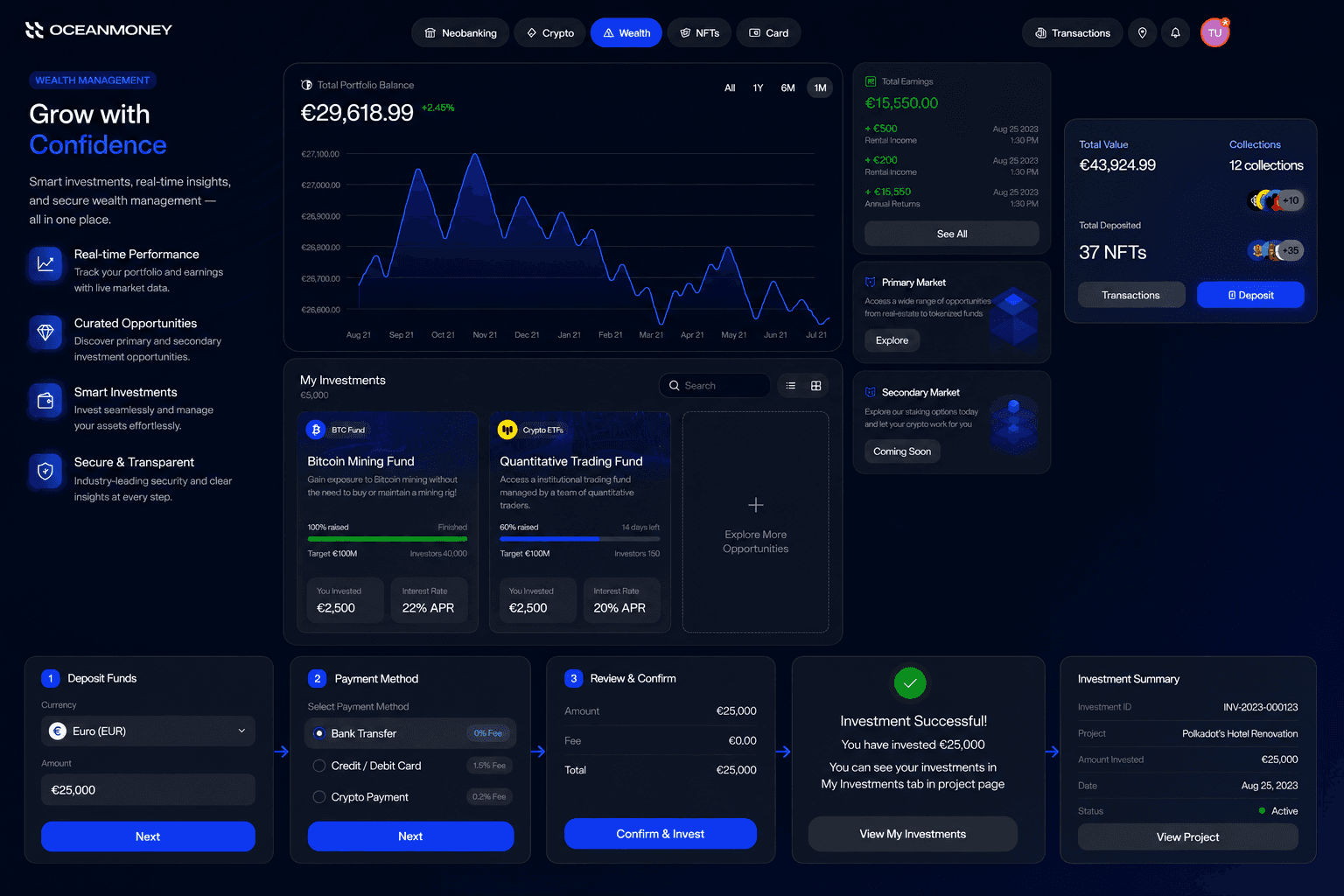
One of the more distinctive areas of OceanMoney was Wealth Management, centered around tokenized real estate.
The experience allowed users to explore real-estate opportunities represented through tokenized shares.
Unlike a simple transaction, this required more information before users could make a decision.
We designed screens around:
Property information
Investment details
Tokenized shares
Value
Returns
Ownership
Portfolio information
Primary Market (Buy Token from the property owners)
Secondary Market (Buy & Sell between users)
Flow
Discover → Understand → Evaluate → Invest → Manage
[VISUAL — Wealth Management]
Physical & Virtual Cards
Bringing OceanMoney into everyday spending
We also designed physical and virtual cards.
The card experience connected the user's cards with their broader OceanMoney account and transaction history.
The interface needed to make key information such as card status, balance, and transactions easy to understand.
We designed screens around:
Property information
Investment details
Tokenized shares
Value
Returns
Ownership
Portfolio information
Flow
Discover → Understand → Evaluate → Invest → Manage

[VISUAL — Physical & Virtual Cards]
Escrow
Designing a trading service
OceanMoney included an Escrow Service for trading.
Because an escrow transaction involves multiple parties and stages, the interface needed to clearly communicate what was happening throughout the process.
Flow
Create Trade → Deposit → Escrow → Verification → Release

[VISUAL — Escrow Trading]
Transactions
Creating clear financial interactions
Transactions became an important shared experience across OceanMoney.
We designed interfaces that allowed users to understand what they were doing before confirming a financial action.
The core interaction followed a familiar pattern:
Select → Configure → Review → Confirm → Complete
Clear hierarchy and confirmation states were particularly important for financial actions.

[VISUAL — Transactions]
Staking & Yield Farming
Designing more complex financial experiences
We also worked on Staking and Yield Farming.
These experiences introduced additional complexity because users were committing assets based on specific conditions and potential returns.
The interface needed to communicate important information before users took action, including:
Asset · Amount · Return · Conditions · Duration · Status
The goal was to make complex financial information easier to understand through clear hierarchy and structured UI.

[VISUAL — Staking]

[VISUAL — Yield Farming]
Design System
Creating consistency across the platform
As the number of product areas increased, maintaining consistency became increasingly important.
We developed a Design System to support the growing OceanMoney platform.
It provided reusable patterns across areas such as:
Typography · Colors · Buttons · Inputs · Forms · Cards · Navigation · Tables · Modals · Statuses
The Design System helped us maintain a consistent visual language while designing new product areas.

[VISUAL — Design System]
Iteration
Designing, reviewing, and refining
OceanMoney followed an Agile approach, so the design evolved continuously.
We didn't design the entire platform once and hand it over.
Instead, we worked through repeated cycles of:
Design → Stakeholder Review → Feedback → Revision
The product was redesigned multiple times as requirements evolved and we received feedback.
This allowed us to resolve issues progressively rather than waiting until the entire product was complete.

[VISUAL — BEFORE / AFTER]
User Feedback
Validating the experience with users
As we moved closer to the Beta version, we also collected feedback through Google Forms.
This gave us an opportunity to complement stakeholder feedback with input from users.
The feedback was particularly useful for understanding how people perceived more complex areas of the platform, such as crypto, staking, yield farming, and wealth management.
For each important result:
Finding → Design consideration
From Alpha to Beta
Growing the platform one experience at a time
OceanMoney evolved incrementally.

[VISUAL — EVOLUTION TIMELINE]
My Role
UI/UX Designer
I worked as a UI/UX Designer within a two-person design team.
What I did
Research
Studying existing financial and digital products to understand established patterns.
Information Architecture
Working on the early product structure and proposing the initial IA.
UX Design
Creating user flows and structuring experiences across different product areas.
UI Design
Designing interfaces from the early Alpha stage through the Beta version.
Design System
Working with reusable components and patterns to maintain consistency across the platform.
Stakeholder Collaboration
Presenting designs, discussing feedback, and iterating throughout the project.
User Feedback
Supporting user-feedback collection as the product progressed toward Beta.
My role was primarily focused on turning product requirements into usable experiences and polished interfaces, while collaborating closely with the other designer, stakeholders, and development team.
Outcome
From an early concept to a broad financial ecosystem
By the time I left OceanMoney, the platform had progressed to the Beta stage.
The product had expanded to include:
NeoBanking
Fiat
Crypto
NFTs
NFT Marketplace
Wealth Management
Tokenized Real Estate
Physical & Virtual Cards
Escrow
Transactions
Staking
Yield Farming
KYC
Dashboard
Design System
Reflection
What I learned from designing OceanMoney
OceanMoney taught me how challenging it is to create consistent experiences across a product with many different financial services.
The interfaces were different, but they still needed to feel like they belonged to the same ecosystem.
The project also taught me the value of iterative design.
Because we worked Agile, designs could evolve as requirements changed, stakeholders provided feedback, and we learned more about the users.
Most importantly, I learned that designing a complex product isn't about making every screen look good individually.
It's about creating clarity, consistency, and familiarity across the entire experience.
Final Showcase
OceanMoney
A multicurrency platform connecting banking, crypto, wealth, and digital assets.

I’d Love to Build What’s Next.
Give me a problem, and I’ll happily feed it to my brain until I find something worth building.